Here, we’ll go over Texas Longhorns snap-count data, offensive line grades, offensive line disruption-allowed statistics and give historical context about Arch Manning and the Texas Longhorns offense coming out of the Oklahoma game.
Click Images to Enlarge
Skill Player Snap Counts and Game-by-Game Percentages of Offensive Snaps (Through Game 6)

***please note that exact snap-count numbers may differ from other sources at times, as the Deep Dig does not count plays as offensive player snaps that are blown dead due to penalty, punts, extra points, field goals, spiked balls, victory formations, kneel-downs, etc.***
Personnel-Grouping Frequency Overall and by Game (Through Game 6)

Tight End Total Snap Counts and Alignment Data (Through Game 6)

Team Target Share By Week (Through Game 6)

Deep Dig OL Grading Scale (each snap by each player is graded as its own independent event)
OL Grades (OU)
LT Trevor Goosby – 58 snaps
1 pressure, 1 TFL, 1 sack allowed
1 knockdown, 1 pin
DEEP DIG GRADE: 78.28
LG Nick Brooks – 60 snaps
3 pressures, 1 TFL allowed
1 holding penalty
1 false start penalty
2 knockdowns
DEEP DIG GRADE: 75.17
C Cole Hutson – 60 snaps
3 pressures, 2 run-stuffs, 1 TFL allowed
3 knockdowns
DEEP DIG GRADE: 74.33
RG DJ Campbell – 60 snaps
1 pressure allowed
1 knockdown
DEEP DIG GRADE: 78.87
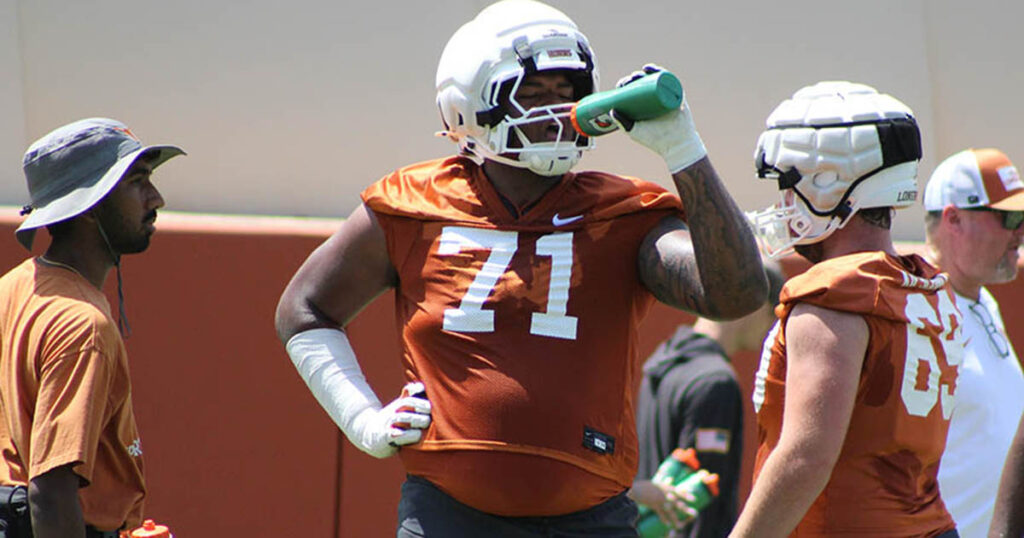
RT Brandon Baker – 60 snaps
1 pressure allowed
DEEP DIG GRADE: 77.67
RT Jaydon Chatman- 2 snaps
No disruption allowed
DEEP DIG GRADE: N/A
OL Grades by Week

OL Snaps-per-Disruption Allowed (Through Game 6)

OL Snaps-per-Disruption by Week (Cumulative, Post-Week)

OL Snaps-per-Disruption Allowed (2025) vs. Historical Context

2025 OL Inclusions to Historical 80-Plus Point Game List

QUICK FINAL THOUGHTS
Obviously, Nick Brooks was under the microscope in his first start following a disastrous in-game introduction to the starting lineup in the Swamp against Florida. And, if you were to base your judgements of Brooks on the first series of the game, you likely would think you were watching the worst player in the history of the program. Brooks committed two penalties and allowed one TFL in the first minutes of the contest, leaving many to say “here we go again.”
Fast-forward two hours or so and Texas is killing clock with a two-score lead and very obviously aiming to run behind him.
The difference through the game was night and day. We’ll sound a lot like Coach Sark here in saying of course Brooks isn’t perfect yet — not even close. The amount of disruption he has allowed through his first 100-plus snaps with the first team has been, by far, the worst in the history of the Deep Dig column, and he really didn’t improve too much in this regard.
He’s a player who’s been cast into a situation where it’s guaranteed that he’s going to fail a few times a game as he learns. You should get used to it, because he’s going to keep starting. We can’t believe we’re saying it, but In pass protection, he’s not only having to learn to set to a new side (moving from the right to the left side of the line), but also to a new depth (moving from tackle to guard). Fundamental things, things that are not learned on the chalkboard, but rather, through repetition and muscle memory. On top of those physical things, THEN you can add the chalkboard stuff with the new protection rules and checks. Ironically, it’s been like the old Brent Venables quote:
Old Nick Brooks out here just blowin’ and goin’.
But we’ll tell you this — while Nick Brooks looks terrible in his disruption allowed numbers, we weren’t the least bit shocked to see he actually graded out acceptably overall even despite them. On the whole, it was an above-baseline performance because Brooks is an athlete who can move and find natural leverage in the run-game then stick on defenders. Texas’ rebound in the run game had to do with Tre Wisner going into Neo-from-the-Matrix mode in his ability to find the zone lane, put his foot in the dirt and blast upfield with vision and instincts. But, it was also obvious that Texas was getting a better flow on the offensive line and generating much better movement off the line of scrimmage than they had done versus Florida by getting back to running the outside-zone concepts that Texas had gotten a little bit away from to start the season.
Texas ran zone 83% of the time versus Oklahoma compared to 64% of the time versus Florida, 72% of the time versus SHSU, 68% of the time versus UTEP, 54% of the time versus SJSU and 47% of the time against Ohio State. By far, it was the greatest dose of zone running we’ve seen this season and it worked.
All the man-gap stuff to start the year likely had a lot to do with playing a left guard in Connor Stroh who did not have the requisite lateral agility and balance to maintain play-side leverage in his base assignments while moving at a zone angle. With a player like Stroh at left guard and a limited player in both strength and mobility at center in Cole Hutson, giving those guys easy down blocks in man/gap schemes was an easy way to give them built-in positioning and leverage while leaving the harder reach blocks, etc. to the more gifted players on the line athletically. Say what you will about Brooks, but he’s an athlete. He can play. He moves bodies and he keeps his feet; he stays on you and has real juice. He might not be consistently good yet, but he can play and he’ll be consistently good at some point if he has a good head on his shoulders — it’s really just a matter of when.
There was improvement from the Florida game to the Oklahoma game for Brooks and we expect that to continue as we head into Lexington, because, despite the initial warts, the LG job should be considered his moving forward.
Onward to Kentucky.