We never thought that a game versus Mississippi State in Davis Wade Stadium would be one that we’ll never forget, but here we are. We’ve recently been asked to flip the order of The Deep Dig’s release in-season to get the offense out first, then do the defense for the second installment of the week—and in this week in particular, it was actually a relief as the offensive review was what we were most curious about coming out of the fog of war.
The game was like a fever dream.
Was the offensive line as bad as it looked at times in the game? How was Arch Manning under so much pressure? What changed in the 4th quarter of the game and why did Texas look like a different football team? An offense that, if it played like that every week, would certainly be a candidate to win every time it steps foot on the field.
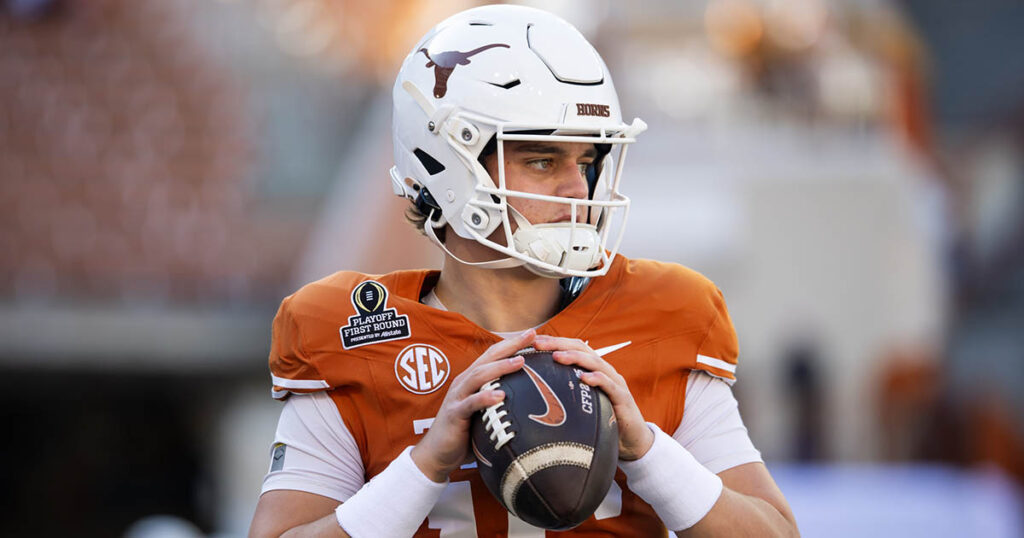
In the end, Arch Manning was pressured 16 times on 53 dropbacks against MSU (30.2% of the time). Basically, once every three throws or so, and that does sound like an awful lot.
But how does it compare to other games? Versus Kentucky, Arch was pressured 15 times on 32 dropbacks (47% of the time). Versus OU, it was 14 pressures on 30 dropbacks (47% of the time). Against Florida, it was 26 pressures on 42 dropbacks (62% of the time). Versus Ohio State, he was pressured 41% of the time.
The pressure rate against Mississippi State was much more akin to the Sam Houston State game (32%), the UTEP game (30%), and the San Jose State game (38%).
We think that the reason it seemed like the game featured as much pressure as Texas’ Power 4-schedule is simply because these guys ran 79 plays on offense, not counting penalties (which, by the way, isn’t sustainable—especially for the defense, but we’ll talk about them later). On that many snaps, this young and inexperienced Texas OL simply is not capable of getting through any game totally clean.
Were we surprised the OL grades came out higher than expected? Of course, but remember the Deep Dig system is not just a grade based on the amount of disruption a player allows. It takes snap-by-snap grades of each player on each snap in their execution of the understood assignment and then makes a grade using that data. The disruption-allowed numbers are certainly important, but they are in addition to the grade. Now, certainly, when a player allows a massive amount of disruption, his grade is logically very likely to be very bad because those plays are graded terribly in the system, but they can make up for it by playing well on other plays. It’s why someone can have more disruption allowed than another player on the line and have a higher grade. You can still score badly on plays where you don’t allow disruption, and your entire game is not judged only on the ones where you do.
With that said, pressure allowed is clearly a critical piece of examining the offensive line, so let’s look at the 16 instances we recorded and see what happened:
- CJ Baxter – sack allowed by not working inside out and failing to mitigate nearest threat right up the B-gap
- Nick Brooks – QB hit allowed, failed to feel the inside help from Robertson and pass off his man to pick up the outside blitzer
- Overload/Nobody’s fault – Free hitter came on a play where Manning stood in there and delivered a strike to Deandre Moore
- Connor Stroh – QB hit allowed, failed to pass off in-slanting 3-tech to Robertson and pick up the stunt with the outside half of his body
- Nick Brooks/Conner Robertson/Tre Wisner – did not record a pressure for either of the OL, because they technically ended up picking up the blitzer with their pass-off, although Robertson did allow him to get to QB-level, which (along with Wisner getting blown backwards right into Manning’s sightline on the other side) caused Manning to flee the pocket. While it looked like a pressure allowed by the OL to the naked eye, upon review, it was more of a matter of the pocket not being totally clean toward the end of Manning’s progression, and Manning saw a lot of space ahead of him to run and pick up the first down
- Connor Stroh – miserable rep from Stroh, really vintage Stroh-level QB hit allowed, reminiscent of the sack that got him benched the first time. Totally got out of position from the start of the rep, barely touched his inside responsibility because he doesn’t have good enough balance and lateral agility to quickly redirect and engage with leverage in space. Manning’s third-down pass sailed high, and DJ Campbell returned to the game at RG to start the next series
- DJ Campbell – recorded a sack allowed because it would have been relatively easy to keep his inside half free instead of turning his hips north and south while sticking with the outside/upfield rusher, which allowed a late-developing effort from the end to get inside of him, but Manning did hold the ball for 3.34 seconds before being sacked, so it was not the most egregious sack allowed by any stretch
- Brandon Baker – pressure allowed by the RT, plain and simple. Showed an uncharacteristic lack of play strength, allowing a step-and-stab move to the inside half of his chest plate to knock him backwards, giving a free line at Manning
- DJ Campbell – garden-variety pressure allowed; didn’t move his feet after initial engagement, outside rip move from the three-tech allowed a late pressure and flushed Manning from the pocket
- Brandon Baker – fairly egregious blown assignment in slide protection leads to a pressure, simply didn’t take his man and gave him free run at Manning, who somehow managed to get the ball out and at least avoid a sack
- Jordan Washington – sack allowed on a play that was doomed from the start, simply let his man inside and have free run at Manning—never had a chance, insta-collapse of the pocket.
- DJ Campbell – simply got bull-rushed and pushed back into Manning’s lap, Manning stood in there and made a great sideline throw to Emmett Mosely despite the interior pocket disruption
- DJ Campbell – just got beat; one shade crossed his face and then actually converted the quick pressure from his outside half. Really uncharacteristic rep from him, which makes us wonder if the injury early in the game had lingering effects. Manning still managed to get the ball out quickly enough to Endries on the completion
- Tre Wisner/Overload – The offensive line picked up their five, and Wisner stepped up to pick up one of two additional blitzers, but got knocked back into Arch; however, it was mostly the total overload that caused the pressure more so than Wisner. Manning took a big hit, but to his credit, got the completion to Livingstone
- DJ Campbell – messed up a stunt pickup and got his hips north and south again; Again, Manning gets the ball out under duress to the flats and Tre Wisner on third down for a critical first-down pickup
- Tre Wisner/Overload – see the description above, it was basically the same defensive pressure design, but this time the blitzer was able to bat down Manning’s pass
Now, what we’re looking at is six of 16 times, the hair-on-fire Arch Manning you saw running for his life through 3 quarters of football wasn’t caused by the offensive line. 10 of them were, and they were bad, there is no getting around that. But 38% of the time Arch was pressured, and everyone was yelling at their TV screen for Kyle Flood to be fired, it was other things: an overload where the defense simply had the numbers advantage and a rusher came free, or a tight end or a running back missing their assignment in pass pro.
We have to hand it to Conner Robertson, too—the OL MVP of this game, no doubt. No disruption allowed at all (outside of a penalty) from a center position that has been one of the clearest, most-leaky positions on the offensive line. It was as much a treat to see him play so well as it was shocking to see Mr. Steady himself, DJ Campbell, really struggle at times.
From the time Texas got the football back with 32 seconds left in the third quarter down 17 (for the first time, that is—gosh, how wild was that game?), Trevor Goosby would have graded out with a 79.8 if we were only grading those final 29 snaps and not the first 50—an improvement, albeit slight. Connor Stroh’s grade would have been a 78.4, a bigger improvement. Robertson’s grade would fall to a 79.8, which is not quite as good as his full-game sample, but the penalty in overtime really brings the grade down more than any bad play. Outside of that one, Robertson only had one negatively graded play in the fourth quarter. DJ Campbell’s 4th quarter grade would have improved to a 77.1, and Baker’s would have been a 79.8, another marked improvement.
The offensive line obviously played much better as Texas mounted its truly unforgettable comeback win, and if they can play like that in a game from start to finish, the offensive line will not be a problem for Arch and the rest of the offense.
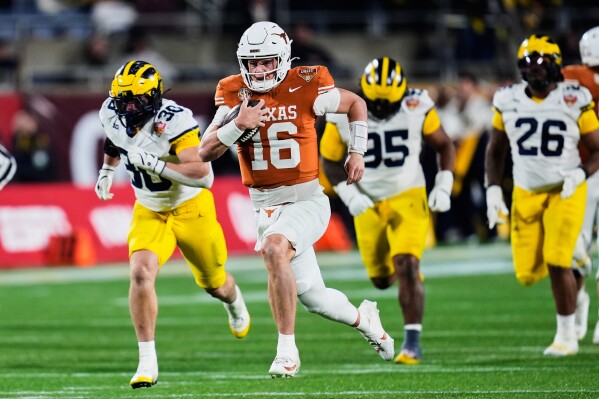
And that’s not to mention Arch Manning himself. He played like a warrior in this game and showed a hose that placed some footballs in spots where only his receivers could get them with pinpoint, laser accuracy. He stood in the pocket tough, even when he knew he was going to get lambasted by the design of the offense’s protection calls against certain pressures, and delivered. It’s hard to remember all the plays he made under duress, because they weren’t all as jaw-dropping as the third-down throw from deep in Texas territory versus OU, but some came close. Others were errant, we get that, but the flashes that Arch Manning brings to the table show the skillset of a quarterback who you can win because of, once he puts it all together. Not one you can win with, or win in spite of, but win because of.
Remarkable. This season could go the way of the dodo bird, and we’ll have to wish-cast about what the future holds with Arch’s hypothetical development from Year 1 to Year 2, and if you look at Texas’ odds to make the CFP this year, you’ll see that the linemakers believe that is indeed the most likely outcome. If you’ve watched the games, you probably feel the same way. Texas has been too much Jekyll and too little Hyde (or whichever one is the bad one—they’ve been more of the bad one), but this is a team that can catch fire and go nuclear. It has the ability to be seriously deadly.
The Mississippi State game taught us that much.