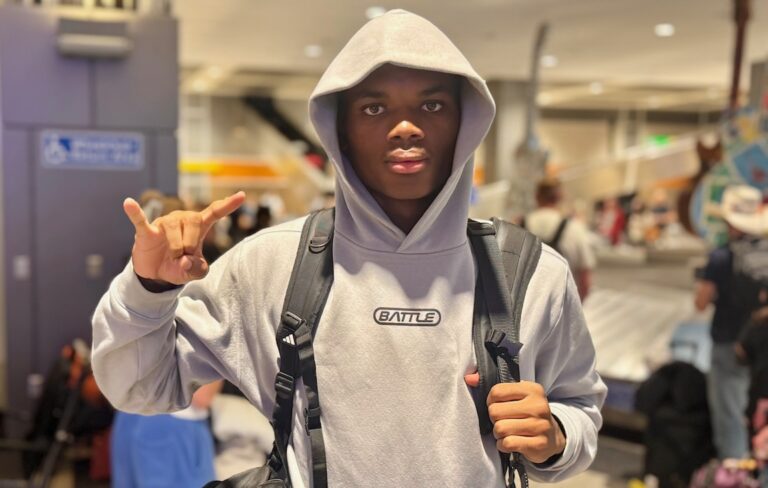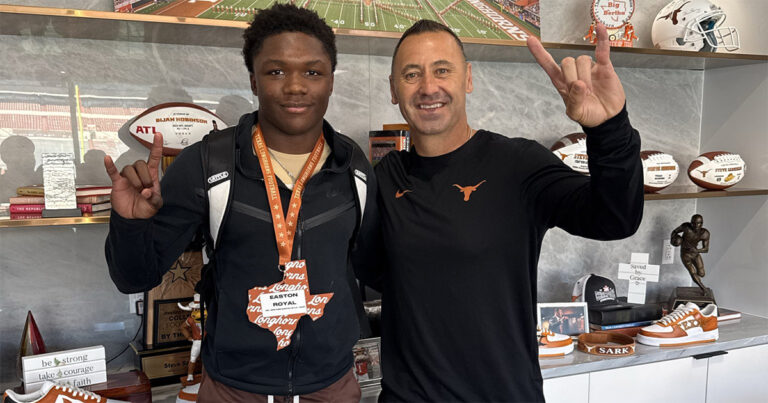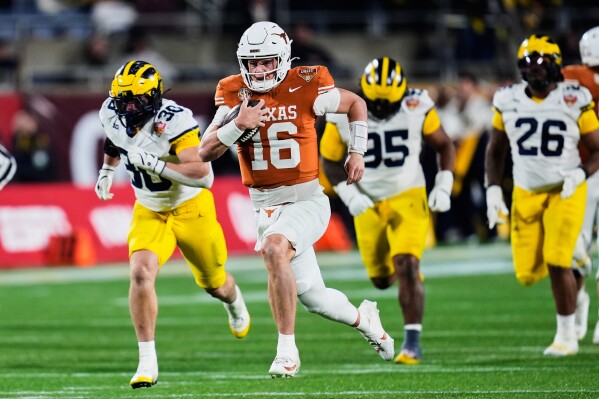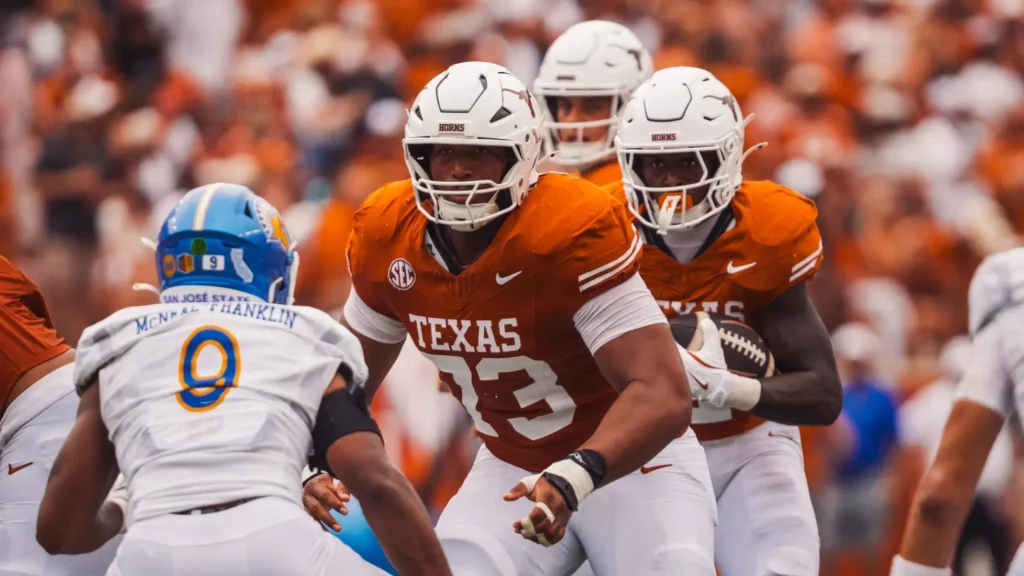
While the likes of Colin Simmons, Anthony Hill and Arch Manning dominate so much of the conversation around the 2025 Texas Football team on Orangeblooods.com, one of the players I’ve been most fascinated with all season is starting right tackle Brandon Baker.
Why?
Whether Baker could have ever known if when he declared during his recruitment that the money he would make in NIL would significantly impact his eventual college decision, he’s become the poster boy of a discussion taking place in the football departments at all of the big boy programs in college football at the moment.
It kind of reminds me of this infamous scene in Moneyball.
This is a conversation between conventional vs. non-conventional, with the non-conventional realizing that winning in college football at the very highest levels might start coming down to who can be the best at card-counting.
Let’s talk about how Brandon Baker fits into all of this…
Conventional Thinking
From a historical standpoint with other players in their first year as starters, he’s not quite as good as Kelvin Banks was in 2022, but he’s ahead of where Connor Williams was in 2015 and almost a statistical wash with Sam Cosmi from 2018 when you look at @Alex Dunlap‘s Deep Dig Archives. To give his play this season even more needed context, he’s basically produced in his second season (first as a starter) as Christian Jones did in his 6th season back in 2023 (third year as a starter).
As things stand, Baker registers as a development success in just about every way you could expect him to. He’s a solid as a rock starter that has a chance to emerge into an All-SEC type of football player before he leaves Austin. He will almost certainly play in the NFL if he stays injury free.
The only real lingering question is whether Baker will get over the hump from being good/very good to great. It’s only about the final level he’ll obtain and there’s no way of guaranteeing either side of the coin. It might happen in 2026. It might happen in 2027 if he stays a fourth season. He might be very good in 2026, go pro early and only reach his highest of heights as pro. It might never happen. All of these things are on the table.
Worst-case scenario – he’s a good to very good starter on a Top 10 team and should be a Sunday player.
Non-Conventional Thinking
Sources have indicated to me over the course of the last couple of years that Baker received more in NIL money in the last two seasons than almost every player in the entire program (pre-20205 recruiting class) not named Colin Simmons. In order to keep us in a ballpark of numbers and nothing so specific that people get distracted by the specificity of it all, I’ve been told it’s very safe to suggest that he’ll likely make between 1.25 to 1.5 million through the first two years as a Texas player.
3 details that matter as move forward in this discussion:
* The majority of the total amount will likely have been earned in year one.
* The amount of money that Baker will make in 2025 is still considered to be very sizable.
* The amount being discussed is only in reference to his first two seasons. I’m under the impression that Baker will be a player that will engage in the type of retention conversations that took place with most of the key players on the team last January when the 2025 season concludes.
* It’s probably not crazy talk to assume that he’ll make more than 2 million through his first three seasons in Austin. He has a massive amount of leverage if he wants to use it when it comes to possible 2026 dollars.
Ultimately, the question that the Longhorns will be asking behind the scenes is whether the investment into Baker proved to be a good one, while also identifying whether there are better ways or more valuable ways to approach the acquisition of talent in the program.
Things the card counters might be asking right now is….
* Was the high cost of securing Baker in year one a sunken/wasted expense that might have otherwise helped a national semi-finalist get over the hump if the money had been reinvested into an area of more immediate help or was it just the rightful cost of offensive line infrastructure that is unavoidable? Did the play through two years justify the money invested through 2 years?
* What is the level of play that would justify such an expense?
* If there hasn’t been enough value created through years 2 based on the money invested, what level of play would have to occur in year three to completely justify the entire process?
But, wait… there’s more!
* Considering this isn’t the best-case scenario, but pretty damn close to it with Baker’s development this season, is this process the correct process to build the foundation of the offensive line around in future seasons, given that there is a ton of added associated risks that would make the investment look like a disaster in no less than 50% of these type situations (see Neto Umeozulu and maybe even D.J. Campbell if we want to keep it 100)* Would the line have simply been better off over a three-year window if you took the entire sum of money spent on Baker for possibly 1 plus-season of play and possibly spread $750,000-$850,000 per year on a proven bad *** tackle (this is basically Kelvin Banks’ cost-level in 2024)?
The questions honestly keep going and going and going. The goal is to optimize the talent acquisition challenge on an annual basis, while limiting the amount of financial and sweat equity risks that go into every single decision that’s made.
The Final Conclusion…
I think both sides are right.
* The recruitment and development of Baker is a 100-percent win for Kyle Flood and the coaching staff. You almost can’t ask for more than he’s currently giving, other than to expect him to be a generational talent and he was never quite expected to be that.
* There’s probably a better and more optimal way of maximizing value/minimizing risks with precious limited natural resources at the offensive line than throwing 2+ million at someone over three years and hoping you don’t roll snake-eyes with no guarantees on the box?
Folks, this is the conversation/battle that is taking place at Ohio State, Georgia, Alabama and Oregon as we speak. Everyone is trying to figure out the right answers.
The people who get it right will have a significant competitive edge.
There are coaches who would tell Steve Sarkisian to trust the process that brought them a player like Baker into the fold, while a tough general manager might step in and say that there’s not enough impact for the cost of doing business and the old way of doing things is a non-optimal approach.
Sarkisian has to make the call. His instincts are no to lean into the card-counting ways of the non-conventional. Meanwhile the conventional will say that the Longhorns are on the cusp of possibly a third straight playoff appearance because of conventional methods and the retort from the non-conventional will be that being conventional this off-season might have robbed him of a chance to win a national championship… right now… this year. And maybe even a season ago.
Pick One
So, I’m curious… are you #TeamConventional or #TeamNonConventional?
It’s one of the questions that I think will define the sport moving forward through the rest of the decade.