
Adam Loewy is one of the top personal injury lawyers in Austin. Adam is a proud graduate of the University of Texas School of Law and started his law firm in 2005. Adam helps people who have been injured in car crashes, slip and falls, dog bites, and other assorted ways. He is actively involved in every case he handles and is always available to talk or text. If you or a loved one has been injured, call the Loewy Law Firm today at (512) 280-0800.
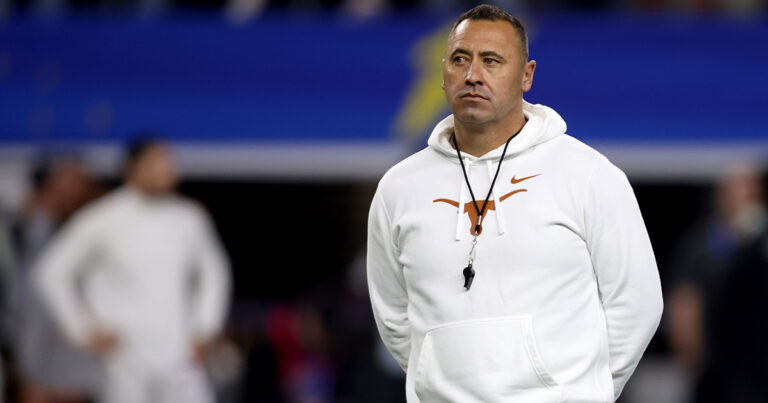
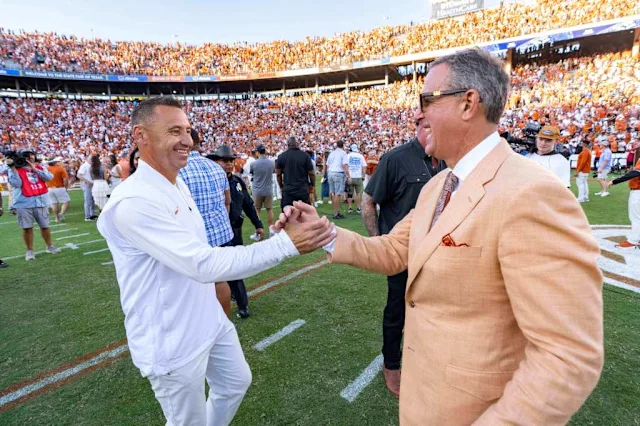
Texas football coach Steve Sarkisian did exactly what a leader should do after his team knocked off Texas A&M on Friday night — launch a campaign that would make most politicians envious. Sarkisian laid out why his 9–3 Longhorns deserve a spot in the College Football Playoff. He challenged the playoff committee to leave his team out of the postseason tournament and gave compelling reasons why doing so would be a disservice to the sport. He delivered that message masterfully. If John Bianco is the man behind Sarkisian’s political-grade messaging, give him a raise on Monday. Heck, Sarkisian should bang the table as often as possible between now and Selection Sunday, accept every sports-show invitation, and fight for his team the way Collin Simmons fights through offensive linemen.
The committee’s decision regarding Texas could shape how the Longhorns approach scheduling for years to come. Sarkisian made it clear that, in his opinion, if Texas had not taken the risk of scheduling Ohio State and instead plugged in a cupcake opponent, there would be no debate about a 10–2 Longhorn team making the playoffs. Texas has long prided itself on playing at least one tough non-conference opponent each season. But Sarkisian warned that tradition could end if Texas is punished for competing against the best. If making the playoffs is simply a race to 10 wins, Sarkisian laid the groundwork for Texas to follow Indiana’s example — without specifically naming that program.
Indiana received heavy criticism after canceling its 2027–28 home-and-home series with Virginia. According to CBSSports.com, “Removing the Virginia series leaves future Indiana schedules with no Power Four opponents until a home-and-home series with Notre Dame that starts in 2030. This season, Indiana begins its campaign with a trio of home games against Old Dominion, Kennesaw State and Indiana State before Illinois comes to Memorial Stadium.” Indiana previously canceled its series with Louisville. College football observers mocked Indiana at the time, but the Hoosiers are now ranked second by the playoff committee, sitting at 11–0, and even if they lose to Ohio State in the Big Ten Championship Game on Saturday, they are guaranteed a playoff berth.
The committee will announce its updated playoff rankings on Tuesday, followed by the final seeding next Sunday. We will know by Tuesday whether Texas has even an outside shot of knocking on the playoff door. And if that door appears bolted shut, the only real drama on Selection Sunday will be whether Texas winds up in the Cheez-It Bowl or hears the name that makes some Longhorn fans cringe — the Texas Bowl.
The next seven days aren’t just enormous for this program — they’re defining.
“All we can do is control what we can control, and that was playing the best football that we could play against some really good teams,” Sarkisian said. “And the fact that we beat an undefeated number-three team in the country [on Friday], that a lot of pundits on television think are the best team in the country with the toughest schedule, the toughest metrics — and we just beat them by two scores. And so to me that’s a pretty impressive win, a pretty dominant win for our team that I don’t know how many other teams can say they have wins like that on their schedule.
“So again, we’ve had some great wins. You know, we beat — I think Oklahoma is the seventh-ranked team in the country right now. We beat them by three scores. And obviously beat Vanderbilt as well. And I get it, we didn’t beat Ohio State. We didn’t beat Georgia. But we played five top-10 ranked teams out of 12 regular-season games, and you look at what some of the other team schedules were in front of us — quite frankly, it’s comical to think what their record would look like if they played those teams.”
Bianco outlined Texas’s résumé and playoff argument on X this past weekend:
- Only team in the nation to beat three AP or CFP Top-10 teams at the time of the game
- Only team with two wins over teams currently ranked in the CFP Top 10
- Only team with three wins over teams currently ranked in the CFP Top 15
- First team since 2019 national champion LSU to beat three AP Top-10 teams in the same season
It would be a disservice not to acknowledge the wins against Oklahoma, Vanderbilt, and Texas A&M. Oklahoma and Texas A&M are playoff-bound. Meanwhile, “Vanderbilt’s six SEC wins are the most in the program’s record book, while the victory capped the first 10-win season for the Dores across their 135-year history,” according to the school’s website.
Unfortunately, the argument for Texas brings back memories of my days as a Pro Football Hall of Fame voter.
There was always controversy every year when our selections were finalized, because good players were consistently left out. The reality is you cannot vote for everybody. Inevitably, I would hear someone in the media — usually a local reporter, but occasionally a national analyst — use the go-to phrase to describe the situation of someone who did not make the cut.
Snubbed.
Whenever someone used that phrase, the retort was simple: Who are you taking out? Because everyone who makes it into the Hall of Fame has a strong argument, too.
Texas needed a lot of dominoes to fall in the regular season finale to climb back into playoff contention, and only one fell.
Ohio State defeated Michigan on Saturday, knocking the 15th-ranked Wolverines out of the playoff race. However, every other team Texas needed to lose did not.
No. 8 Oklahoma (10-2) defeated LSU, 17-13 (regular season over)
No. 9 Notre Dame (10-2) defeated Stanford, 49-20 (regular season over)
No. 10 Alabama (10-2) defeated Auburn, 27-20 (advanced to SEC Championship Game)
No. 11 BYU (11-1) defeated UCF, 41-21 (advanced to Big 12 title game)
No. 12 Miami (10-2) defeated Pitt, 38-7 (regular season over)
No. 13 Utah (10-2) defeated Kansas, 31-21 (regular season over)
No. 14 Vanderbilt (10-2) defeated Tennessee, 45-24 (regular season over)
No. 15 Michigan (9-3) lost to Ohio State, 27-9 (regular season over)
No. 16 Texas (9-3) defeated Texas A&M, 27-17 (regular season over)
In order for Texas to climb back into the playoff race, the committee would need to move the Longhorns from No. 16 to No. 10. That would require the committee to leapfrog Texas over seven teams that all took care of business, which seems highly unlikely. There is data supporting a Texas playoff argument, but the counterargument is where the Longhorns find themselves in trouble.
Once you get past the Ohio State loss, Texas is being penalized primarily for its losses against Florida and Georgia.
No other team may have as many wins against Top 10 teams, but nobody has a loss as bad as Florida on its résumé. Texas cannot lose to a Florida team that was defeated by USF at home this season. Florida fired its coach midseason and finished 4–8.
Now, Sarkisian compared the Florida loss to Notre Dame’s defeat by Northern Illinois in 2024. He argued that the committee allowed Notre Dame into the playoffs despite that loss. The issue is Notre Dame finished the regular season 11–1, not 9–3. And Notre Dame did not have a 25-point loss during the regular season.
That 25-point loss against Georgia is the other setback working against Texas. You cannot get blown out late in the season. If that loss had been respectable, maybe the committee could consider moving this team higher. But the committee’s job is not to find ways to put Texas in the playoffs. It’s Texas’s job to make the decision easy for the committee, and the losses to Florida and Georgia make that conversation difficult.
Should Texas revisit its nonconference scheduling after this season?
Yes, but not to support the argument that the Ohio State loss is keeping Texas out of the playoffs.
Texas should revisit its nonconference scheduling for a simple reason:
The Longhorns need to work smarter, not harder.
The SEC is moving to nine conference games next season. Meanwhile, Texas is playing Ohio State next season. That means Texas is setting itself up for 10 difficult games every season, while other programs – some in less competitive conferences than the SEC – have decided to take an easier route to the playoffs.
Look at Texas’s upcoming schedule:
2026 Schedule
Nonconference
• Sept. 5 — Texas State (Austin)
• Sept. 12 — Ohio State (Austin)
• Sept. 19 — UTSA (Austin)
SEC
• Arkansas
• At Texas A&M
• Oklahoma (in Dallas)
• Florida
• Ole Miss
• Mississippi State
• At LSU
• At Missouri
• At Tennessee
2027 Schedule
Nonconference
• Sept. 11 — Michigan (Austin)
• Sept. 18 — UTEP (Austin)
SEC
• At Arkansas
• Texas A&M
• Oklahoma (in Dallas)
• Auburn
• Georgia
• Kentucky
• At Alabama
• At South Carolina
• At Vanderbilt
2028 Schedule
Nonconference
• Sept. 2 — Louisiana Tech (Austin)
• Sept. 9 — Notre Dame (South Bend, Ind.)
• Sept. 16 — UTSA (Austin)
SEC
• Arkansas
• At Texas A&M
• Oklahoma (in Dallas)
• LSU
• Missouri
• Tennessee
• At Florida
• At Ole Miss
• At Mississippi State
2029 Schedule
Nonconference
• Sept. 1 — ULM (Austin)
• Sept. 15 — UTEP (Austin)
• Sept. 22 — Notre Dame (Austin)
SEC
• At Arkansas
• Texas A&M
• Oklahoma (in Dallas)
• Alabama
• South Carolina
• Vanderbilt
• At Auburn
• At Georgia
• At Kentucky
A nine-game SEC schedule is hard enough to navigate.
Putting ego and bravado aside, is the nonconference risk worth the reward?
The playoff-bound teams seem to think so.
Texas originally scheduled those nonconference games because it was difficult to get butts in the seats for Big 12 games. Considering Texas plays Oklahoma in Dallas, it was hard to get Texas fans out for Kansas, Kansas State, and West Virginia. The nonconference games created more interest for the fan base.
Moving to the SEC solved that problem, and holding onto those previously scheduled games might be creating another issue.
I have campaigned against the non-conference schedule since the Big 12 days. I always believed it did not leave Texas with any margin of error. Longhorn athletic director Chris Del Conte and I have discussed the non-conference schedule annually since he arrived in Austin. I asked him about it earlier this year during the SEC Spring Meetings.
Anwar: “Chris, you’ve done a good job. You’ve scheduled Ohio State, you’ve scheduled Michigan, but prior to that Florida, Georgia. Do you feel like you have the incentive to continue to schedule tough out-of-conference teams based on what you’ve seen so far?”
Del Conte: “Without question. We’ve always talked about the regular season being valuable. I think, at a place like Texas, you also have to think about what’s good for the game. Our fans want to see great games.
“College football loves to see — and we should provide — unbelievable, compelling games during the regular season. I think, Anwar, you and I had a discussion one time about needing to water down the non-conference schedule. Water it down and go play.
“I’m a firm believer that, for us, playing Ohio State, Michigan, USC, LSU — we just signed Notre Dame — those games are important to college football. We’ve talked previously about not playing A&M, Nebraska, not playing Oklahoma. I grew up watching those games. I think about the Pac-10 not being in existence. Those things are just evolution.
“But if you have a responsibility to create compelling matchups during the regular season, you should. And at our brand, the University of Texas, we won’t change that philosophy.”
If Texas misses the playoffs, Del Conte may need to revisit that philosophy.
The next seven days aren’t just enormous for this program — they’re defining.