
Adam Loewy is one of the top personal injury lawyers in Austin. Adam is a proud graduate of the University of Texas School of Law and started his law firm in 2005. Adam helps people who have been injured in car crashes, slip and falls, dog bites, and other assorted ways. He is actively involved in every case he handles and is always available to talk or text. If you or a loved one has been injured, call the Loewy Law Firm today at (512) 280-0800.
I will never forget a team meeting I sat through in The Tampa Tribune newsroom when I was in my early 20s in the 1990s. That was a time when newspapers didn’t just matter – they ruled. The Tribune had a helicopter pad on top of the building and bureaus stretching from Tallahassee to Miami. Money flowed. Deadlines were sacred. If your paper didn’t arrive on time, you called circulation. Sunday mornings meant a thick stack of newsprint, ads stuffed inside, coffee on the table, and a columnist you had to read before noon.
The purpose of that meeting? To discuss something new and apparently harmless called “the Internet.”
Editors gathered to calm growing anxiety about how this so-called fad might impact newspapers. I can still hear the scoffing. The dismissive laughter. The confidence. We were told the internet would never truly matter because people love the feel of newspapers in their hands. They love the paper cuts, the ink on their fingers, the ritual. The internet, we were assured, was the little brother – interesting, maybe cute – but never a real threat to big brother.
Years later, we had another meeting. This time, it was about a new platform called “Twitter.” Once again, concerns were raised. Once again, leadership waved them away. It was a fad. It would pass. Reporters were explicitly told not to have personal Twitter accounts. The company account was all that mattered. Individuals didn’t matter. The people on Twitter, we were told, weren’t interested in personalities.
Fast forward.
The Tampa Tribune no longer exists. The building is gone. The property along the Hillsborough River – once the beating heart of the newsroom – has been replaced by condominiums. The Tribune didn’t die because journalism died. It died because it refused to adapt in real time while the world changed around it.
The Texas Longhorn football program now finds itself standing at a similar crossroads, one that has swallowed entire industries whole. Kodak once owned photography. Blockbuster laughed at Netflix. Radio Shack assumed people would always need a store to buy batteries. Sears, Borders, and Toys “R” Us all believed their brand power was enough to outlast change. None of them adjusted quickly enough. None of them thought the rules would truly apply to them. And that, more than anything, is the danger of believing yesterday’s success guarantees tomorrow’s relevance.
High school development versus instant transfer portal success.
This is the moment when programs either evolve in real time or start writing their own obituaries.
There is a reason high school recruiting still matters, and anyone pretending otherwise isn’t being honest. Programs are still built, not rented, through development. That’s where culture is established. That’s where accountability is taught. A locker room full of players who came up together understands expectations in a way a collection of short-term answers never fully can.
Recruiting and developing high school players is how staffs protect themselves from volatility and create sustainability. It’s how you avoid being at the mercy of the portal every December.
But college football no longer operates on the same clock it did even five years ago.
Development takes time, and time is now the one luxury this sport doesn’t afford. Coaches don’t get three years to wait for a position group to grow up.
They don’t get mulligan seasons while talent matures. When a starter leaves unexpectedly, or a room proves thinner than expected, the solution isn’t patience – it’s replacement. The portal has become the fastest way to stabilize a roster, and pretending otherwise doesn’t make a program principled. It makes it exposed.
High school recruiting gives you a base.
The transfer portal gives you margin for error.
The mistake programs make is treating this as an either-or proposition. It isn’t. The teams thriving right now aren’t abandoning development – they’re supplementing it. They’re using the portal to fix misses, cover injuries, replace experience, and accelerate timelines. They’re not waiting for hope to mature when help is already available.
The portal didn’t eliminate development.
It just stopped rewarding stubbornness.
A few years later, high school recruiting seems like the cake batter, the foundation you can’t skip if you want anything worth serving. It’s the flour, the eggs, the structure that gives the program shape and stability. But no one wins a bake-off by stopping there.
The transfer portal is the icing, the filling, the finishing touches that turn something functional into something complete. It’s what covers mistakes, adds flavor, and makes the final product presentable in a results-driven world.
Ketch has noted the impeccable research by Sam Khan of The Athletic multiple times. In a recent article by Khan, he pointed out how the success of playoff semifinal teams has been rooted in the transfer portal:
https://www.nytimes.com/athletic/69…eams-roster-construction-recruiting-portal-2/
Here is a portion of Khan’s outstanding research as it relates to the two teams that have advanced to the national championship game, with updated records:
No. 1 Indiana (15-0)
• Percentage of starts from recruits: 35.1
• Percentage of starts from transfers: 64.9
• Average recruiting rank 2022-25: 51.2
• Team talent composite rank: 72
Offensive starters recruited (4)
• WR Charlie Becker (3-star)
• LT Carter Smith (3-star)
• RG Bray Lynch (3-star)
• RT Adedamola Ajani (3-star)
Offensive starters who transferred in (7)
• QB Fernando Mendoza (Cal)
• RB Roman Hemby (Maryland)
• WR Elijah Sarratt (James Madison)
• WR E.J. Williams (Clemson)
• TE Riley Nowakowski (Wisconsin)
• LG Drew Evans (Wisconsin)
• C Pat Coogan (Notre Dame)
Defensive starters recruited (5)
• DL Mario Landino (3-star)
• LB Rolijah Hardy (unranked)
• LB Isaiah Jones (3-star)
• CB Jamari Sharpe (3-star)
• S Amare Ferrell (3-star)
Defensive starters who transferred in (6)
• DE Mikail Kamara (James Madison)
• DL Tyrique Tucker (James Madison)
• DL Dominique Ratcliff (Texas State)
• LB Aiden Fisher (James Madison)
• CB D’Angelo Ponds (James Madison)
• S Louis Moore (Ole Miss)
No. 10 Miami (13-2)
• Percentage of starts from recruits: 46.3
• Percentage of starts from transfers: 53.7
• Average recruiting rank 2022-25: 10
• Team talent composite rank: 15
Offensive starters recruited (6)
• RB Mark Fletcher Jr. (4-star)
• WR Malachi Toney (4-star)
• LT Markel Bell (junior college)
• LG Matthew McCoy (3-star)
• RG Anez Cooper (3-star)
• RT Francis Mauigoa (5-star)
Offensive starters who transferred in (5)
• QB Carson Beck (Georgia)
• WR Keelan Marion (BYU)
• WR CJ Daniels (LSU)
• TE Alex Bauman (Tulane)
• C James Brockermeyer (TCU)
Defensive starters recruited (5)
• DE Rueben Bain Jr. (4-star)
• DL Justin Scott (5-star)
• DL Ahmad Moten (3-star)
• LB Wesley Bissainthe (4-star)
• CB OJ Frederique Jr. (3-star)
Defensive starters who transferred in (6)
• DE Akheem Mesidor (West Virginia)
• LB Mohamed Toure (Rutgers)
• CB Ethan O’Connor (Washington State)
• S Zechariah Poyser (Jacksonville State)
• S Jakobe Thomas (Tennessee)
• DB Keionte Scott (Auburn)
Have these teams found the cheat code?
Time will tell.
What is clear is that they’ve adjusted in real time, and it’s hard to argue with the results many of these programs have produced by leaning into the transfer portal.
The real challenge in this new era is identifying which players actually deliver a return on investment. Before NIL and the portal, a staff could sign a four- or five-star prospect, put him in the weight room, coach him up, and wait. Development took time, and patience was part of the process. If it took two or three years for a player to make an impact, so be it.
That model is rapidly becoming outdated.
Now, if a player doesn’t produce immediately, the program may ask him to take a pay cut.
On the flip side, if a player doesn’t produce, he may blame the coaching staff and enter the transfer portal.
If he does produce, he wants a raise.
If the program can’t meet that number, he’s in the portal anyway.
And then there are coaches like UTSA’s Jeff Traylor, who are effectively running minor-league or feeder programs, developing talent only to watch it get purchased by schools with deeper pockets.
Texas is in a real-time dilemma.
To be clear, every program in the country is trying to figure out how to handle this new era. I am not insinuating that Sarkisian is on an island by himself.
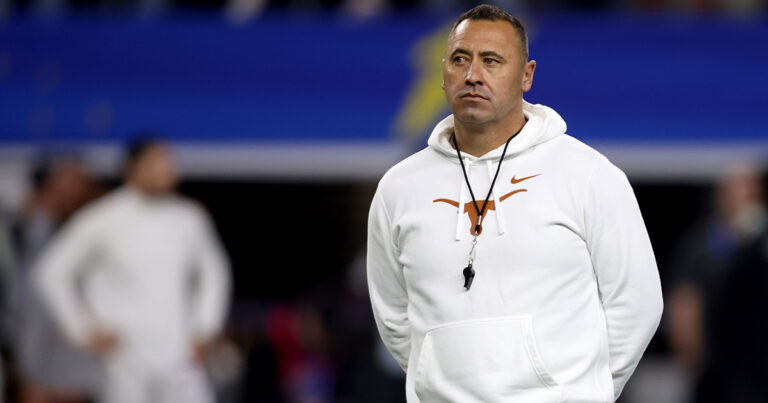
But there are choppy waters that need to be navigated by Sarkisian and Texas general manager Brandon Harris.
Sarkisian has repeatedly said he does not want to live in the portal. He is fine with obtaining a few players through it, but Sarkisian views high school recruiting as his base.
“The transfer portal is great,” Sarkisian recently said. “Like I said, it fills needs for us. But at the end of the day, when you really look at us year in and year out, the bulk of what we do is in high school recruiting.”
Sarkisian’s challenge is that there is nothing he can do to make those high school players stay in the program and develop for four or five years.
Every player who steps on campus is on a one-year deal. If the player is patient, he may give you more than that.
The question that Sarkisian and other coaches have to ask themselves is simple.
Do you invest in an unproven high school commodity or a proven college football player who is in the portal?
Many programs are realizing the ROI is better with transfer portal players than high school athletes, especially when you factor in attrition.
The deadline for players to enter their names in the transfer portal is Friday.
Twenty-two Texas players have either entered the portal or announced their intentions to do so, while the Longhorns have acquired 11.
High school development versus instant transfer portal success.
This is the moment when programs either evolve in real time or start writing their own obituaries.
Just ask my former Tribune editors.
Click Here To Read The Rest:
https://forums.orangebloods.com/index.php?threads/the-sunday-pulpit-via-loewy-law-firm-adapt-or-become-obsolete.445242/#post-15202602